Flapless Implant Surgery
Learn more about flapless implant surgery treatment options.
Book Free ConsultationWhat Is Flapless Implant Surgery and How Is It Performed?
Flapless implant surgery is a minimally invasive surgical approach that allows dental implants to be placed into the jawbone without raising a gum flap in suitable cases. Rather than lifting the gum tissue as in conventional implant surgery, a small access point is created at the planned implant site.
By limiting disruption to the gums and surrounding tissues, this approach may help reduce post-operative bleeding, swelling and tenderness. Reducing or avoiding the need for stitches and preserving the soft tissues as much as possible may also contribute to a more comfortable recovery.
For flapless implant surgery to be appropriate, the jawbone and surrounding anatomical structures must provide suitable conditions for this approach. The surgical technique is therefore selected individually following a detailed clinical and radiographic assessment.

Digital Planning for Flapless Implant Surgery
Three-dimensional imaging plays an important role in planning the appropriate position of implants for flapless implant surgery. The bone structure and surrounding anatomical structures are assessed digitally, allowing detailed implant planning to be carried out before the surgical procedure.
3D Imaging
The height and width of the jawbone, together with the sinuses, nerve canals and surrounding anatomical structures, are assessed using three-dimensional imaging. Where appropriate, data from an intraoral digital scan can also be incorporated into the planning process.
Virtual Implant Planning
The position, angle and depth of each implant are planned using three-dimensional images. The available bone, surrounding anatomical structures and the planned dental restoration are considered together to determine the appropriate implant position.
Guided Implant Placement
In suitable cases, a custom surgical guide is created based on the digital treatment plan. The guide helps transfer the planned implant position, angle and depth to the surgical procedure in a controlled manner.
Benefits of Flapless Implant Surgery
By limiting disruption to the gums and surrounding tissues, flapless implant surgery may help provide a more comfortable post-operative recovery in suitable cases.
Less Tissue Disruption
As the gum tissue does not need to be extensively lifted, the soft tissues around the implant site can be preserved as much as possible.
Reduced Swelling and Tenderness
A less invasive surgical approach may help reduce swelling and tenderness following the procedure.
Reduced Need for Stitches
Depending on the surgical technique used, stitches may not be required following implant placement.
More Comfortable Recovery
Limiting disruption to the gums and surrounding tissues may contribute to a more comfortable early healing period and make it easier to return to everyday activities.
Who May Be Suitable for Flapless Implant Surgery?
Flapless implant surgery may be considered for people with sufficient bone volume and suitable anatomical conditions. The most appropriate surgical approach is determined individually following a clinical examination and three-dimensional imaging.
Clinical Conditions for Flapless Surgery
Sufficient bone volume to allow the implant to be placed in the planned position
Jawbone and surrounding anatomical structures that are suitable for a flapless approach
No requirement for extensive bone grafting or additional soft-tissue surgery
For Those Seeking a More Comfortable Approach
Those who prefer a surgical approach with less disruption to the gums and surrounding tissues
Those who value the potential for reduced swelling and tenderness following the procedure
Those seeking a more comfortable early recovery period
Flapless implant surgery may not be appropriate in every case. Where additional bone or soft-tissue support is required, a different surgical approach may be recommended.
Differences Between Flapless and Conventional Implant Surgery
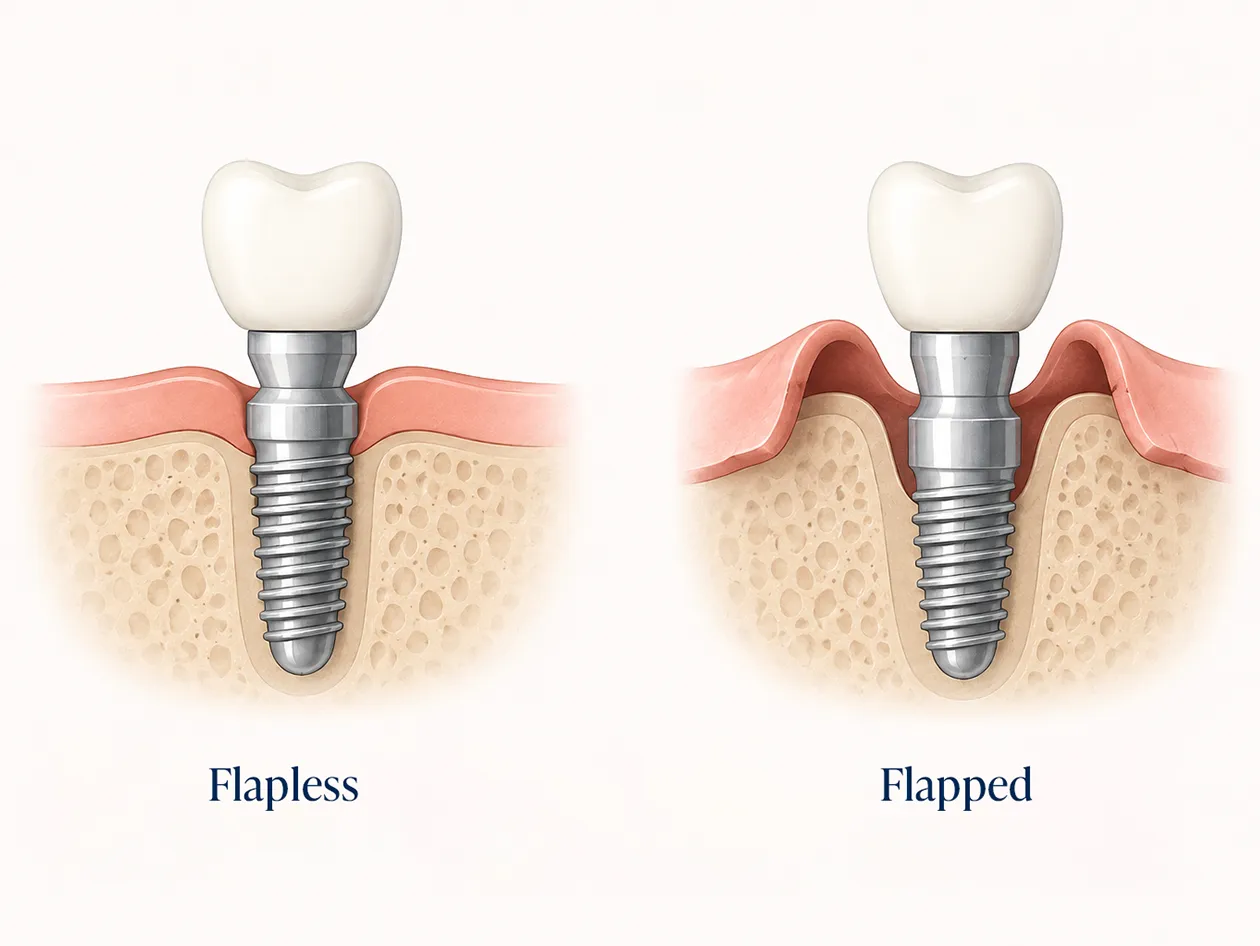
Both approaches are used to place dental implants into the jawbone. The main difference lies in how the implant site is accessed and how the surrounding tissues are managed during surgery.
Surgical Approach
In flapless implant surgery, the implant site is accessed through a small opening without extensively lifting the gum tissue in suitable cases. With conventional implant surgery, the gum tissue is lifted to provide direct access to and visibility of the implant site, and stitches may be placed afterwards where required.
Healing Process
Because there is less disruption to the gums and surrounding tissues, the early recovery period following flapless implant surgery may be more comfortable. Post-operative swelling and tenderness may also be reduced.
Aesthetics and Comfort
Preserving the soft tissues as much as possible may be particularly beneficial in areas where the appearance of the gums is important. More limited tissue disruption may also contribute to greater comfort following the procedure.
Which Approach Is Most Appropriate?
The choice between flapless and conventional implant surgery depends on factors such as bone volume and quality, gum tissue, the location of the planned implant and whether additional surgical procedures are required. The aim is not to use a flapless approach in every case, but to select the most appropriate surgical technique to support safe and predictable implant placement.
Frequently Asked Questions About Flapless Implant Surgery
Dental implant surgery is usually performed under local anaesthesia, with the aim of preventing pain during the procedure. As flapless surgery involves less disruption to the gums and surrounding tissues, post-operative swelling, tenderness and discomfort may be reduced in suitable cases.
No. Flapless implant surgery requires sufficient bone volume and suitable anatomical conditions. Conventional implant surgery may be more appropriate where bone augmentation, more extensive soft-tissue procedures or direct visualisation of the bone is required. The most appropriate approach is determined following a clinical examination and three-dimensional imaging.
Early recovery varies from person to person. As flapless surgery involves less disruption to the surrounding tissues, it may help reduce swelling and tenderness during the first few days and allow a more comfortable return to everyday activities. The process of the implant integrating with the jawbone, known as osseointegration, is a separate stage of healing and typically takes several months.
No. A surgical guide is not required in every case. Where appropriate, a custom surgical guide can be created using CBCT imaging and digital scan data to help transfer the planned implant position, angle and depth to the surgical procedure in a controlled manner. Whether a surgical guide is used depends on the individual treatment plan.
In some suitable cases, temporary teeth may be fitted on the same day when bone conditions are appropriate and sufficient primary implant stability is achieved. However, flapless implant surgery and same-day temporary teeth are separate clinical decisions. Whether temporary teeth can be provided is assessed according to implant stability, the treatment area and the planned restoration.
Get in Touch
Speak with our team via phone or WhatsApp to learn more about this treatment and receive personalised advice.